Showing posts with label Punjab & Haryana High Court. Show all posts

Sunday, August 6, 2023

Punjab & Haryana HC in Harnek Singh vs. State of Punjab [02.06.2023]

Neutral Citation No:=2023:PHHC:080920-DB 

IN THE HIGH COURT OF PUNJAB & HARYANA AT CHANDIGARH 
CWP-22863-2021 

Date of decision : 02.06.2023 

HARNEK SINGH                                                                                                 -PETITIONER 
VERSUS 
STATE OF PUNJAB AND ORS.                                                                    -RESPONDENTS 

CORAM: HON'BLE MR. JUSTICE SURESHWAR THAKUR 
                HON'BLE MR. JUSTICE KULDEEP TIWARI 

Present: Mr. Rai Singh Chauhan, Advocate with 
Mr. Rohit Sapehiya, Advocate and 
Ms. Deepika Chauhan, Advocate for the petitioner. 
Ms. Monika Jalota, Sr. DAG, Punjab. 
Mr. B.S. Ichhewal, Advocate for the respondent No.8. 

*** 

KULDEEP TIWARI, J.

1. Through the instant writ petition, the petitioner has sought the issuance of a mandamus upon the official respondent(s) concerned, to consider the grievance of the petitioner, as carried in the representation dated 13.08.2021 (Annexure P-5), and, also to conduct an inquiry in terms of the directions, as carried in Annexure P-6, issued by the respondent No.2, on the premise that the Sarpanch of the Gram Panchayat concerned (respondent No.9), has constructed a community hall over the disputed pond (Chappar) in Village Badial by filling it with sand, which exists for the last more than 50 years and was used for common purposes by the inhabitants of the village concerned.

2. By placing reliance upon the judgment passed by the Hon'ble Supreme Court, in case titled "Jagpal Singh and others V/s State of Punjab and others", 2011(1) ICC 742, the learned counsel for the petitioner has argued that the factual matrix of the present case causes breach of the directions, as laid down by the Hon'ble Supreme Court in the case (supra), therefore, he has sought the indulgence of this Court, to take stern action against the private respondent No.9 and has also sought the restoration of the disputed pond to its original condition.

3. This Court, while issuing notice of motion in the present case, had passed the hereinafter extracted order:-
"The petitioner has approached this Court praying for a writ of mandamus directing the respondents to consider the grievance of the petitioner as highlighted in the representation dated 13.08.2021 (Annexure P-5), whereby the Deputy Commissioner, Hoshiarpur was called upon to look into the matter with regard to the encroachment on the Pond (Chappar) of village Badial as the pond has been filled in and construction is being carried out on the same. It has been asserted that in the revenue record as well as the other known facts for more than 50 years, the pond was in existence which has been filled in for carrying out illegal constructions. This act on the part of the Gram Panchayat itself, amounts to encroachment on the pond i.e. Khasra No.438, in violation of the provisions of the statute as also the judgment of the Hon'ble Supreme Court in 'Jagpal Singh and others Vs. State of Punjab and others, Civil Appeal No.1132 of 2011 decided on 28.01.2011' and as on to the judgment of this Court in 'CWP-9885-2020 titled as Terjinder Kumar and others Vs. State of Punjab and others' decided on 15.07.2020 (Annexure P-3). It has further been asserted that not only this, even the Director Rural Development and Panchayat, Punjab had vide communication dated 08.09.2021 addressed to the District Development and Panchayat Officer, Hoshiarpur (Annexure P-6) and vide letter dated 15.09.2021 sent by the Director Land Records, Punjab (Annexure P-7) to the Deputy Commissioner, Hoshiarpur had called upon these authorities to inquire into the allegations that has been made by the petitioner with regard to filling up of the pond and making construction therein but despite the same, no action has been taken. Petitioner has also approached the Deputy Commissioner, Hoshiarpur vide complaint dated 08.10.2021 (Annexure P-8) but without any response thereto as well. He, on this basis, asserts that the action on the part of the Gram Panchayat is totally unacceptable and in violation of the law laid down by the Hon'ble Supreme Court and this Court and also in violation of the statutory provisions of the Punjab Village Common Lands (Regulation) Act 1961.
Learned counsel for the State of Punjab prays for an adjournment to seek instructions. Let the Deputy Commissioner, Hoshiarpur and also the District Development and Panchayat Officer, Hoshiarpur respondent Nos.4 and 6 respectively file their specific affidavit as to what action has been taken by them in pursuance to the representation/ directions received from the office of the Director Rural Development and Panchayat Punjab and Director Land Records, Jalandhar, respondent Nos.2 and 3, within a period of four weeks from today.
Status quo with regard to construction, if any, be maintained on the land in question i.e. Khasra No.438 till the next date of hearing. The Deputy Commissioner, Hoshiarpur shall ensure that no further construction is carried out on the land referred to above.
Adjourned to 21.12.2021."

4. In response to the notice being issued by this Court, the official respondent(s) concerned furnished their reply, through an affidavit sworn by respondent No.6, i.e. District Development and Panchayat Officer, Hoshiarpur. However, a perusal of the reply (supra) reveals rather a completely contrasting picture, than the one canvassed by the petitioner, in the instant writ petition. The reply (supra) unfolds that Village Badial Sainian is a small hamlet, comprising of only about 26 houses, with a population of about 150 individuals. It further reveals that, as per the relevant revenue record(s), a "Gair Mumkin Pond", measuring 64 Marlas, was reserved during consolidation operations, but within the "abadi deh" of the village concerned, over Khasra No.438/1 (3-4), however, a government primary school was constructed over some part of the khasra number (supra), inasmuch as, the said school was constructed approx. upon 5-6 marlas, about 50 years ago. Another chunk of 5-6 marlas of land, in front of the said school, i.e. between the street and the school, is also being used for ingress and egress from the school. Apart from this, another area measuring 30 marlas is used as playground by the children of the village concerned. Ultimately, after utilization of the above portions of land, in the above manner, which was rather reserved for "Gair Mumkin Pond", only an area measuring 10 marlas remained vacant, however, this area was also used for accumulating sullage and dirty water of the village concerned. The reply (supra) is supported by a detailed map, depicting therein the exact position, as exists at the spot. It further transpires from the reply (supra) that a Gurudwara is also situated near the above land reserved for "Gair Mumkin Pond".

5. Therefore, considering the ill effects of accumulation of sullage and dirty water, in the above portion of "Gair Mumkin Pond" falling in "abadi deh", as well as the health hazards arising therefrom, an NRI of the village concerned, namely Tirath Singh, who was interested in philanthropist activities, offered to donate 30 marlas of his private land for relocation of the pond. Even the said NRI also volunteered to lay the pipelines upto the relocated pond and also to construct a community hall after filling the said pond existing within "abadi deh".

6. In pursuance of the above welfare gesture of the NRI concerned, the Gram Sabha concerned, vide Resolution dated 10.06.2020, resolved to re- locate the pond outside the "abadi deh". Moreover, the resolution (supra) also gathered support from the circular bearing No. C/H-95/22769 dated 29.08.1995, issued by the Civil Surgeon, Hoshiarpur, who opined therein that a new pond cannot be excavated within the Phirni/Lal Lakir of the village concerned. Faced with the above life hazard problems and the instructions issued by the Civil Surgeon concerned, the inhabitants of the village concerned, decided to relocate the pond outside the "abadi deh", with the financial assistance of an NRI of the village concerned.

7. Therefore, a new pond was got excavated on 30 marlas of land, which was donated by the NRI concerned, and the NRI concerned also got connected the out drains of sullage water of the village concerned, through a pipeline to the newly excavated pond, at his own expenses, which were to the tune of approx. Rs.2.91 lacs. Even the Executive Engineer concerned had also approved the laying of pipeline to the newly excavated pond, being technically correct.

8. After shifting of the original pond outside the "abadi deh", which was existing over Khasra No.438/1, upon an area measuring 10 marlas, the area of the original pond was filled up with sand and thereupon, a community hall was constructed thereon for the utilization by all the inhabitants of the village concerned. An expenditure of approx. Rs.15 lacs was incurred on the construction of this community hall, which was borne by all the residents of the village concerned and by the NRI concerned.

9. The hereinabove recorded facts reveal that the petitioner has filed the instant petition by concealing the material facts from this Court. Moreover, from a perusal of the record(s), it is revealed that the petitioner is neither an inhabitant nor a proprietor of the village concerned, which consequently gives rise to an inference that he has filed the present writ petition, not for any bonafide reason, rather for some extraneous consideration. This inference gains corroboration from the petitioner failing to make complete compliance of the order made by this Court on 09.01.2023, wherein, this Court had specifically directed the petitioner to place on record, the requisite document(s) to establish his locus standi, however, the petitioner has placed on record only a Jamabandi, which depicts that he has a very minimal share in a joint land in the village concerned. Apart from this Jamabandi, the petitioner has not produced any document on record to establish, that he is the original proprietor or pattidar of the village concerned. The order made by this Court on 09.01.2023 is reproduced hereunder:-
"1. After hearing the learned counsel for the parties for some time, the learned counsel for the petitioner, at this stage, has not been able to prima facie justify his locus standi to maintain the instant petition, before this Court.
2. Therefore, as prayed for, he is directed to place on record the list of bartandarans, prepared, and, maintained by the Patwari of the halqa concerned, with echoings thereins of the petitioner being the bartandaran in the halqa concerned.
3. List on 11.4.2023."

10. Although, the concealment of material facts (supra) and the non- establishment of locus by the petitioner, are sufficient to dismiss the present petition with costs, however, since the dispute involved in the present case, relates to re-location of a pond from within the "abadi deh" to a site outside the "abadi deh", therefore we deem it apt to further examine the matter.

11. It is not the case of the petitioner that the Sarpanch of the Gram Panchayat concerned had, with any malafide intention, re-located the pond, rather out of the total area reserved for pond, some portion had already been utilized by the government, by constructing a school about 50 years back, which still exists at the site concerned. Furthermore, some portion is used for ingress and egress from the said school, and, also as a playground by the children of the village concerned. After such utilization of this area, only an area measuring 10 marlas remained vacant, however, that too was used for discharge of sullage and dirty water of the village concerned. The consequence of such discharge of sullage and dirty water was spreading of life endangering diseases in the village concerned, thereby making the inhabitants of the village exposed to life hazards. Although the above acts, which though are result of a bonafide necessity of the entire villagers, may not have the sanctity of law, however, since the same have been done for the benefit of all the inhabitants of the village concerned and with no particular individual getting benefit from the above acts of Gram Sabha, resultantly the acts (supra) cannot invite wrath of this Court.

12. Insofar as the judgment (supra), as relied upon by the learned counsel for the petitioner, is concerned, the same also does not have any apt applicability to the case in hand. The Hon'ble Supreme Court, in the judgment (supra), while directing the respective Chief Secretaries of all the State Governments to prepare a scheme for eviction of illegal unauthorized occupants, upon Gram Sabha/Gram Panchayat/Shamlat deh land, and thereafter, restoring possession thereof to the Gram Panchayat(s) concerned, also has assigned relaxations for regularizing possession(s) in exceptional cases, vis-a-vis, where the land has been granted under some government notification to landless labourers or members of the Scheduled Castes/Scheduled Tribes, or, where there is already a school, dispensary or other public utility existing on such land. Since, over some portion of the disputed land, a government school and a community center have been constructed, thereby with the same subserving a public purpose, or, the same being an educational institution and a public utility center, thus make them fall within the exception (supra), as carved in the judgment (supra) and therefore, the same are required to be regularized. The directions issued by the Hon'ble Supreme Court, in the judgment (supra), are extracted hereunder.
"22. Before parting with this case we give directions to all the State Governments in the country that they should prepare schemes for eviction of illegal/unauthorized occupants of Gram Sabha/Gram Panchayat/Poramboke/Shamlat land and these must be restored to the Gram Sabha/Gram Panchayat for the common use of villagers of the village. For this purpose the Chief Secretaries of all State Governments/Union Territories in India are directed to do the needful, taking the help of other senior officers of the Governments. The said scheme should provide for the speedy eviction of such illegal occupant, after giving him a show cause notice and a brief hearing. Long duration of such illegal occupation or huge expenditure in making constructions thereon or political connections must not be treated as a justification for condoning this illegal act or for regularizing the illegal possession. Regularization should only be permitted in exceptional cases e.g. where lease has been granted under some Government notification to landless labourers or members of Scheduled Castes/Scheduled Tribes, or where there is already a school, dispensary or other public utility on the land."

13. Village ponds are the epicenter of rural life and they also maintain balance in a fragile ecosystem. In the present case, the pond has been virtually converted into a disposal point for sullage and dirty water, which instead of maintaining balance of ecosystem in the village concerned, rather became a flash-point for spreading of various diseases. Therefore, considering the fact that the pond has already been converted into a school building and a community center, we do not find it appropriate to now order the demolition of these buildings, which are in fact, meant for the benefit of the inhabitants of the village concerned, especially considering the fact that an alternate pond has also been excavated, on the land donated by the NRI concerned, outside the "abadi deh". Therefore, in the light of peculiar facts and circumstances, we deem it appropriate to issue specific directions to the official respondent(s) concerned to prepare and thereafter, implement a comprehensive action plan for proper functioning of the newly constructed pond, so that the same can serve the purpose, which otherwise was meant to be served by the original pond.

(i) to ensure the transfer of the newly excavated pond's land in favour of the Gram Panchayat concerned, which was gifted by the NRI concerned for this purpose;

(ii) to ensure that in future, the land of pond shall not be converted or used for any other purpose;

(iii) to ensure proper installation and maintenance of treatment facilities in the village, so that sullage water of the village concerned can be safely disposed off;

(iv) to ensure proper disposal of sullage water after treatment and to ensure that the same is not disposed of in the pond;

(v) to ensure identification of sources of pollution(s) near the pond and thereupon ensure removal of such pollutant(s);

(vi) to ensure environment restoration and replenishment of surface water;

(vii) Department of Rural Development and Panchayat shall ensure providing the requisite infrastructure, such as pumping machinery, channels and pipe system for utilization of pond water;

(viiii) Department of Rural Development and Panchayat shall further ensure providing the necessary treatment facilities for proper maintenance and management, in a scientific manner, of the village pond;

Apart from the above issued directions, no further intervention is required to be made in the present writ petition. The present petition is disposed of accordingly.

The compliance report in respect of the above issued directions be submitted by the competent and responsible functionary concerned, within three months from today.

(SURESHWAR THAKUR)                                         (KULDEEP TIWARI) 
    JUDGE                                                                      JUDGE 

02.06.2023 
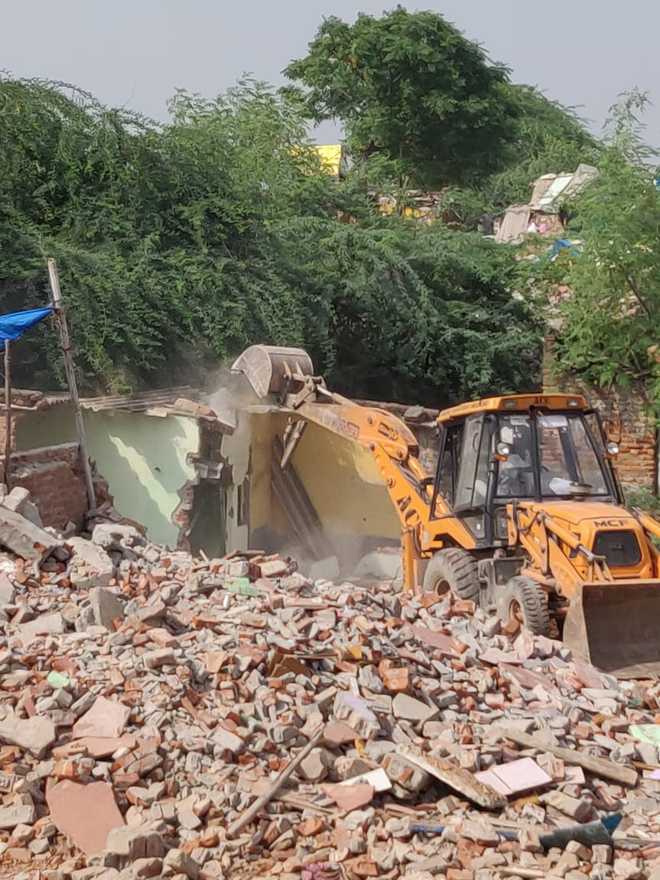
Monday, May 23, 2022

Can't encourage encroachment on panchayat land: Punjab and Haryana High Court [05.05.2022]

Chandigarh, May 5

The Punjab and Haryana High Court has ruled that the courts cannot encourage illegal encroachment upon gram panchayat land by regularising its purchase. The assertion by the Bench of Justice Augustine George Masih and Justice Sandeep Moudgil came on a petition challenging order dated August 11, 2017, passed by Punjab Director, Rural Development and Panchayat-cum-Commissioner, upholding the order of eviction dated October 1, 2013, passed by Jalandhar District Development and Panchayat Officer-cum-Collector.

The matter was brought to their notice after Bir Pind gram panchayat in Nakodar sought eviction of the petitioner. Referring to the provisions of the Punjab Village Common Lands (Regulation) Rules, his counsel contended a village resident could be given/sold land for residential purposes. Taking a note of the submissions, the Bench contended the very purpose for which the statutory provisions were incorporated under the Punjab Village Common Lands (Regulation) Act, and the rules framed there under, would be rendered redundant if the prayer was accepted.

Dismissing the petition, the Bench added the petitioner’s contention was that he belonged to the Scheduled Caste. The contention could not be accepted since he did not fall in the landless category and his counsel was unable to show any provision under the scheme.

Link to article: https://www.tribuneindia.com/news/punjab/cant-encourage-encroachment-on-panchayat-land-punjab-and-haryana-high-court-392192

_____________________________________________________________________________________


IN THE HIGH COURT OF PUNJAB AND HARYANA AT CHANDIGARH 
CWP-23434-2017 

Date of Decision: April 27th, 2022 

Kewal Krishan                                                             ...Petitioner 
Versus 
State of Punjab and Others                                     ...Respondents  

CORAM: HON'BLE MR. JUSTICE AUGUSTINE GEORGE MASIH 
                 HON'BLE MR. JUSTICE SANDEEP MOUDGIL 

Present: Mr. Vikram Singh, Advocate, for the petitioner.
Mr. S.P.S.Tinna, Addl. A.G. Punjab, for the State. 
Ms. Sonia G. Singh, Advocate, for respondent No. 4. 


AUGUSTINE GEORGE MASIH, J. 

(ORAL)

Petitioner has approached this Court impugning the order dated 11.08.2017 (Annexure P-5) passed by the Director, Rural Development and Panchayat-cum-Commissioner, Punjab-respondent No. 2 upholding the order of eviction dated 01.10.2013 (Annexure P-3) passed by the District Development and Panchayat Officer-cum-Collector, Jalandhar-respondent No. 3 preferred by the Gram Panchayat Bir Pind, Tehsil Nakodar, District Jalandhar-respondent No. 4 for ejectment of the petitioner being in illegal possession of the Gram Panchayat land.

On 12.10.2017, when the case came up for hearing before this 1 of 5 Court, the Court had issued notice on a statement made by the counsel for the petitioner that the petitioner is ready to pay the market price of the subject land where he has been found in illegal possession.

In pursuance to this notice issued by the Court, reply on behalf of respondents No. 1 to 3 by way of affidavit of District Development and Panchayat Officer, District Jalandhar dated 29.11.2019 has been filed. Similarly, reply on behalf of respondent No. 4-Gram Panchayat has also been filed by the authorized Panch of the Gram Panchayat, wherein the stand taken is that the petitioner is not covered by the Policy dated 14.08.2008 as the said Policy is with regard to the landless workers whereas the petitioner holds approximately 10 Marla of land, of which he is the owner. The relevant provisions of the Policy dated 14.08.2008 have been reproduced therein and under the said provisions, the case of the petitioner would not be covered. The said eligibility criteria reads as follows:-

"1. Who will be entitled under this scheme.
1) The beneficiary under this scheme must have constructed residential house over the Shamlat land of Gram Panchayat land in the concerned gram sabha area and is registered as voter in the gram sabha area.
2) The beneficiary belongs to Scheduled Caste or Scheduled Tribe including Bazigar community.
3) The beneficiary under this scheme must be married or un-married above the age of 45 years.
4) The beneficiary should be landless worker."

It has further been stated in the reply that this land, which is the subject matter of the present writ petition, is reserved for pond and in the light of the judgment of the Hon'ble Supreme Court in Jagpal Singh and others vs. State of Punjab and others, 2011 (1) RCR (Civil), 912, the benefit, as has been claimed by the petitioner, cannot be granted to him. Reference has been made to para Nos. 22 and 23 of the said judgment, which reads as follows:-

"22. Before parting with this case we give directions to all the State Governments in the country that they should prepare scheme for eviction of illegal/unauthorized occupants of Gram Sabha/Gram Panchayat/Poramboke/Shamlat land and these must be restored to the Gram Sabha/Gram Panchayat for the common use of villagers of the village. For this purpose of the Chief Secretaries of all State Government/Union Territories in India are directed to do the needful, taking the help of other senior officers of the Governments. The said scheme should provide for the speedy eviction of such illegal occupant, after giving him a show cause notice and a brief hearing. Long duration of such illegal occupants or huge expenditure in making constructions thereon or political connections must not be treated as a justification for condoning this illegal act or for regularizing the illegal possession. Regularization should only be permitted in exceptional cases e.g. where lease has been granted under some Government notification to landless labourers or members of Scheduled Caste/Scheduled Tribes, or where there is already a school, dispensary or other public utility on the land.

23. Let a copy of this order be sent to all Chief Secretaries of all States and Union Territories in India who will ensure strict and prompt compliance of this order and submit compliance report to this Court from time to time."

Learned counsel for the petitioner asserts that the petitioner is claiming the benefit under Rule 10 and Rule 12 (4) of the Punjab Village Common Lands (Regulation) Rules 1964. He contends that according to these rules, a resident of the village can be given/sold land for residential purposes. A perusal of these rules would show that the intent and purpose of selling the land by the Gram Panchayat is to help out the people who do not have any land. It is not intended to help the encroachers of the land of the Gram Panchayat. Otherwise the very purpose, for which the statutory provisions have been incorporated under The Punjab Village Common Lands (Regulation) Act, 1961 and the rules framed thereunder, would be rendered redundant.

That apart, it may be pointed out that the Courts cannot be a party to encourage illegal encroachment upon the Gram Panchayat land by regularizing or accepting such prayer, as has been made in the present writ petition, for purchasing the land of the Gram Panchayat which they have encroached. The position would have been different assuming the case of the petitioner would have been covered by the Policy, as has been framed by the Government of Punjab for the landless labourers or the Scheduled Caste or Scheduled Tribe.

Learned counsel for the petitioner states that the petitioner is a scheduled caste but since he does not fall in the landless category, this contention of the learned counsel for the petitioner cannot be accepted in the 4 of 5 light of the fact that the counsel has not been able to show any provision under the scheme which would entitle the petitioner to the benefit, as has been claimed by him.

The present writ petition being devoid of any merit, therefore, stands dismissed.

                (AUGUSTINE GEORGE MASIH)                              (SANDEEP MOUDGIL) 
                                    JUDGE                                                                   JUDGE 


April 27th, 2022

Monday, February 7, 2022

Punjab & Haryana HC in Gurmukh Singh vs. State of Punjab [09.09.2021]

IN THE HIGH COURT OF PUNJAB AND HARYANA AT CHANDIGARH
CWP No. 17706 of 2021

Date of Decision: 09.09.2021 
Gurmukh Singh ...Petitioner 

Versus 

State of Punjab and others ... Respondents 

CORAM:- HON'BLE MR. JUSTICE AUGUSTINE GEORGE MASIH 
                  HON'BLE MR. JUSTICE ASHOK KUMAR VERMA 

Present: Mr. Sahil Soi, Advocate for the petitioner. 

ASHOK KUMAR VERMA, J. 

1. This writ petition has been filed for quashing of the order dated 25.06.2021 (Annexure P-5) passed by the Director, Rural Development and Panchayat Department (Exercising the Power of Commissioner), SAS Nagar Mohali, Punjab at Mohali and the order dated 17.10.2017 (Annexure P-3) passed by the District Development and Panchayat Officer-cum-Collector, Jalandhar. 

2. Brief facts leading to the filing of this petition are that Gram Panchayat, Maheru filed a case before the District Development and Panchayat Officer-cum-Collector, Jalandhar against the petitioner and six others alleging that the petitioner has illegally encroached the Gram Panchayat land (26 Kanal), Khewat No.285, Khatauni No.359, Khasra No.19//16/4 (0-14), 17/3 (2-0), 22/2 (3-13), 23 (7-4), 24/1 (6-4), 22//3/1 (5-19), 4/1 (0-10) as per Jamabandi 2005-06, Hadbast No.55, situated in Village Maheru, Tehsil Nakodar, District Jalandhar. The land in dispute is common property under the control of Gram Panchayat, Maheru and the income from the said land was being used for the development and progress of the village. The petitioner got the land in dispute on lease in the name of his relatives and did not give back the same to the Gram Panchayat, Maheru. After hearing the Gram Panchayat and considering the revenue record, the Collector came to the conclusion that there is illegal encroachment on the land in question and as such he passed eviction order dated 17.10.2017 (Annexure P-3) directing the petitioner to immediately vacate the land in dispute and handover the vacant possession to the Gram Panchayat. Aggrieved against the aforesaid order the petitioner filed appeal before the Director, Rural Development and Panchayats, Punjab at Mohali which was also dismissed vide order dated 25.06.2021 (Annexure P-5). Thus, the present petition has been filed challenging the aforesaid orders.

3. Learned counsel for the petitioner, inter alia, submits that the impugned orders are based upon conjectures and surmises and are perverse to the evidence available on record. Neither the land in dispute was used for common purpose nor its income was ever used for development of village and it was never leased to the petitioner or his relatives as alleged by the Gram Panchayat. Prior to 1964 and during consolidation, the land in dispute was shown as ‘Shamlat Patti Udhowal’ in the ownership column and later on vide mutation No.2250, the said entry was changed wrongly from ‘Shamlat Patti Udhowal’ to ‘Panchayat Deh’ on the basis of a letter dated 24.06.1964. As per law no mutation can be sanctioned on the basis of a letter or notification. The said entry is wrong, illegal and void which was changed without hearing anyone. The land in dispute which was earlier in the name of private persons had been transferred in the name of the petitioner and other performa respondents vide sale deed 18.05.1979 and the land in dispute does not come under the definition of ‘Shamlat Deh’. Learned counsel also submits that the revenue authorities have not taken into consideration these facts. Therefore, the impugned orders being illegal may be quashed.

4. We have anxiously considered the submissions of the learned counsel for the petitioner and gone through the paper-book. 

5. We find no substance in the submissions of the learned counsel for the petitioner. The submissions and the assertions of the petitioner are bald, baseless and imaginary and have no leg to stand. There is no evidence on record to show that the disputed land belongs to the petitioner. On the other hand, the Collector examined the issue thoroughly in its order dated 17.10.2017. After appreciating the evidence the Collector arrived at the conclusion that as per Jamabandi for the year 2005-06, in the column of ownership ‘Panchayat Deh’ is mentioned, the petitioner was is in illegal possession of the land in dispute and the same has remained in control of Gram Panchayat. The Collector rightly ordered eviction of the petitioner from the land in dispute vide impugned order dated 17.10.2017, which was also upheld by the Commissioner vide impugned order dated 25.06.2021 passed in the appeal filed by the petitioner observing that there is nothing on record to show that the petitioner is owner of the land in dispute. In the absence of any cogent evidence and material on record in favour of the petitioner, we find no reason to interfere with the findings of fact recorded by the revenue authorities in their comprehensive and speaking orders. 

“13. We find no merit in this appeal. The appellants herein were trespassers who illegally encroached on to the Gram Panchayat land by using muscle power/money power and in collusion with the officials and even with the Gram Panchayat. We are of the opinion that such kind of blatant illegalities must not be condoned. Even if the appellants have built houses on the land in question they must be ordered to remove their constructions, and possession of the land in question must be handed back to the Gram Panchayat. Regularising such illegalities must not be permitted because it is Gram Sabha land which must be kept for the common use of the villagers of the village. 

XXX XXX XXX 

23. Before parting with this case we give directions to all the State Governments in the country that they should prepare schemes for eviction of illegal/unauthorised occupants of the Gram Sabha/Gram Panchayat/poramboke/shamlat land and these must be restored to the Gram Sabha/Gram Panchayat for the common use of villagers of the village. For this purpose the Chief Secretaries of all State Governments/Union Territories in India are directed to do the needful, taking the help of other senior officers of the Governments. The said scheme should provide for the speedy eviction of such illegal occupant, after giving him a show-cause notice and a brief hearing. Long duration of such illegal occupation or huge expenditure in making constructions thereon or political connections must not be treated as a justification for condoning this illegal act or for regularising the illegal possession. Regularisation should only be permitted in exceptional cases e.g. where lease has been granted under some government notification to landless labourers or members of the Scheduled Castes/Scheduled Tribes, or where there is already a school, dispensary or other public utility on the land.”

The aforesaid propositions have been reiterated by Hon’ble Supreme Court in Joginder and another Vs. State of Haryana and others, 2021 (2) R.C.R (Civil) 109.

7. We are of the considered opinion that the aforesaid ratio of law laid down by the Supreme Court is fully applicable to the case of the petitioner. 

8. In view of the above, we find no merit in the present petition, which is accordingly dismissed.


             (ASHOK KUMAR VERMA)                         (AUGUSTINE GEORGE MASIH) 
                            JUDGE                                                                 JUDGE

Monday, December 27, 2021

News: Common land proprietorship remains with owner, rules Punjab and Haryana High Court [09.06.2021]

Says Sector 42A doesn’t take away title

Chandigarh, June 8

In a significant judgment on land laws, the Punjab and Haryana High Court has ruled that the title of a landowner in the land reserved for common purposes or the ‘Jumla Mushtarka Malkan’ land was still with the property owner, even after insertion of Section 42A in the East Punjab Holdings (Consolidation and Prevention of Fragmentation) Act.

Justice Anil Kshetarpal ruled Section 42A on “prohibition to partition the land reserved for common purposes” did not take away the title of the proprietor in the land reserved for common purposes at the time of consolidation. However, the control and management of such land would continue to vest in the gram panchayat or the state government till it was used, or was capable of being used, for village common purposes.

The ruling by Justice Kshetarpal came on a petition filed against the state of Punjab and other respondents by Labh Singh and other petitioners. Going into the technical aspects of the matter, Justice Kshetarpal asserted Rule 16 (ii) of the East Punjab Holdings (Consolidation and Prevention of Fragmentation) Rules provided that the proprietary rights of land reserved for village common purposes, by imposing pro-rata cut on landholding of the owners at the time of consolidation, would continue to vest in the proprietary body of the estate or estates concerned.

Justice Kshetarpal added a five-Judge Bench of the Supreme Court held in 1965 that the land so carved out by imposing a pro-rata cut for common use of the villagers would not result in divesting the ownership of the proprietors or proprietary body. Subsequently, another five-Judge Bench again held that the proprietors would continue to be the owner and there was no divesting of the title. Another Bench also held that the ownership of Jumla Mushtarka Malkan land did not vest in the gram panchayat.

But the state counsel insisted that the proprietary body stood divested of the title of the ‘Jumla Mushtarka Malkan’ land in view of Section 42A. Justice Kshetarpal asserted the Act did not provide for acquisition, divesting, confiscation, seizure, impounding, appropriation or annexation of the proprietary rights. “If the argument of state’s counsel is accepted, the provision most likely would be rendered unconstitutional,” he said.

Wednesday, December 22, 2021

Punjab & Haryana HC in Gurdev Singh & Ors. vs. Joint Development Commissioner, Director, Panchayats (IRD) & Ors. [12.10.2021]

IN THE HIGH COURT OF PUNJAB AND HARYANA AT CHANDIGARH
CWP No. 10744 of 2021 (O&M)

Decided On: 12.10.2021
Gurdev Singh and Ors.

Vs.

Joint Development Commissioner, Director, Panchayats (IRD) and Ors.

Hon'ble Judges/Coram:
Augustine George Masih and Ashok Kumar Verma, JJ.

Counsels:
For Appellant/Petitioner/Plaintiff: O.P. Goyal, Sr. Advocate and Manjit Singh, Advocate
For Respondents/Defendant: Ashish Gupta, Advocate

DECISION

Ashok Kumar Verma, J.

CM-15253-CWP-2021

This is an application filed for amendment of the writ petition. For the reasons recorded therein, CM is allowed. Amended writ petition is taken on record.

CWP No. 10744 of 2021

1. The petitioners have approached this Court through this petition invoking extraordinary writ jurisdiction under Articles 226/227 of the Constitution of India seeking quashment of the impugned order dated 27.09.2013 (Annexure P-11) vide which respondent No. 2-Collector (Panchayat Lands), District Development and Panchayat Officer, Patiala has accepted the petition under Section 7 of the Punjab Village Common Lands (Regulation) Act, 1961 (for short, "The Act of 1961") filed by respondent No. 3-Gram Panchayat, Balbehra against the petitioners and the impugned order dated 30.12.2020 (Annexure P-13) vide which respondent No. 1-Joint Development Commissioner dismissed the appeal filed by the petitioners against the order dated 27.09.2013 (Annexure-P-11).

2. Having gleaned insight into the paper-book, it transpires that respondent no. 3-Gram Panchayat filed a petition under Section 7 of the Act of 1961 for ejectment of the petitioners alongwith one Sapinder Singh from the land comprising in Khewat No. 458, Khatauni No. 957, Khasra Nos. 6//19 (6-19), 20 min (3-16), 21 (8-0), 7//16 (10-9), 13//2 (8-0), 9 (8-0), 12 (8-0), 19 (8-0), 22 (2-0), 6//22 (8-0), total 71 Kanal 4 Marlas, situated at village Balbehra, Block Sanour, Tehsil and District Patiala. In the petition under Section 7 of the Act of 1961, the Gram Panchayat has averred that the land in question was being used for common purpose/benefit of the inhabitants of village Balbehra and the respondents (petitioners herein) are illegally occupying the said land and as such they are liable for eviction/ejectment from the land in dispute. After hearing the parties, vide order dated 27.09.2013 (Annexure P-11), respondent no. 2-Collector came to the conclusion that the Gram Panchayat is owner of the land in dispute and the petitioners have encroached upon the said land and as such he directed the petitioners' eviction from the land in dispute and it has been further directed that whosoever has taken the possession unauthorizedly on the land of the Gram Panchayat from time to time, the Gram Panchayat has been directed to take action for the recovery of compensation/costs against the petitioners for keeping possession on the land unauthorisedly. Aggrieved against the aforesaid order, the petitioners filed an appeal which has also been dismissed vide order dated 30.12.2020 (Annexure P-13) passed by the Commissioner. Hence, the petitioners have approached this Court challenging the impugned orders dated 27.09.2013 and 30.12.2020 (Annexures P-11 and P-13).

3. Learned counsel for the petitioners, INTER ALIA, vehemently submits that the impugned orders are wrong and illegal. Learned counsel submits that proforma respondent no. 4-Sapinder Singh had purchased the land in dispute from previous owners, namely, Babu Singh and others vide sale deeds dated 09.08.2011 and 12.08.2011 (Annexures P-3 and P-3A) and thereafter, the petitioners purchased the said land from proforma respondent no. 4-Sapinder Singh. As such the petitioners are bona fide purchasers of the land in dispute. The Gram Panchayat has totally failed to prove its case as no evidence has come on record to prove that the Gram Panchayat is the owner of the land in dispute. Learned counsel for the petitioners thus submits that the impugned orders are totally wrong and against the law as the same are based on conjectures and surmises.

4. In contrast, learned counsel for the respondent no. 3-Gram Panchayat submits that the official respondents no. 1 and 2 have acted in accordance with the provision of the Act of 1961. Respondent no. 3-Gram Panchayat has been found to be the owner of 71 kanals 4 marlas of land. He submits that earlier aforesaid Babu Singh etc. had filed petition against Gram Panchayat under Section 11 of the Act of 1961 in the Court of Collector/Divisional Deputy Director Panchayats, Patiala which was accepted in their favour vide order dated 22.11.1994 and respondent no. 3-Gram Panchayat had filed appeal against the aforesaid order before the Joint Development Commissioner (IRD) which was decided on 04.04.1996 in favour of the respondent no. 3-Gram Panchayat and the aforesaid order dated 04.04.1996 has been duly exhibited as Mark A-2 before the Collector which is apparent from the impugned order dated 27.9.2013. In the said order dated 04.04.1996, it has been held that the Gram Panchayat was the owner of the land in dispute and the said land had been given on lease at the rate of Rs. 35 per acre to Babu Singh etc. by the Gram Panchayat which is reflected from the Jamabandis for the years 1978-79 and 1988-89. Aggrieved against the aforesaid order dated 04.04.1996 passed by the Joint Development Commissioner, said Babu Singh etc. filed CWP No. 7225 of 1997 titled as Nahar Singh and others vs. Joint Development Commissioner (IRD), Punjab, Chandigarh and others before this Court wherein CM-10195 of 2011 had been filed for withdrawal of the writ petition and the same was dismissed as withdrawn vide order dated 05.08.2011 passed by this Court. Thus, learned counsel for respondent no. 3-Gram Panchayat submits that the aforesaid order dated 04.04.1996 passed by the Commissioner holding that the land in dispute belongs to the Gram Panchayat is still in operation as the same has not been set aside and as such it attained finality. Further the land of the Gram Panchayat cannot be sold by private person to another private person. Learned counsel, therefore, submits that the Collector and the Joint Development Commissioner have rightly ordered eviction of the petitioners from the land of the Gram Panchayat.

5. We have anxiously considered the submissions of the learned counsel for the parties and gone through the paper-book.

6. We are not impressed with the submissions of the learned counsel for the petitioners which are gravely misconceived and misrepresented. It is not disputed that Babu Singh etc. had filed CWP No. 7225 of 1997 against the order of ejectment dated 04.04.1996 passed by the Joint Development Commissioner (IRD), Punjab exercising the power of Commissioner. The said writ petition was dismissed as withdrawn vide order dated 05.08.2011. As such on withdrawal of the said writ petition, the order dated 04.04.1996 passed by the Joint Development Commissioner had not been set aside and the same attained finality and remained operative till date. It is also not disputed that in the aforesaid order dated 04.04.1996, it has been held by the Joint Development Commissioner (IRD), Punjab that Babu Singh etc. had been given the land in dispute on lease basis which is mentioned in the Jamabandi for the year 1978-79 and 1988-89. It is settled proposition of law that upon an order not being set aside for a long period of time, it attains finality and upon attaining finality, it becomes operative for all times to come and it matters little as to whether it was erroneous unless it is demonstrated that the finding was obtained by fraud or due to lack of jurisdiction. Vide order dated 04.04.1996, the Commissioner found the land in dispute belonging to Gram Panchayat-respondent no. 3 and as such, the said land, once proved to be belonging to the Gram Panchayat cannot be sold by a private person to another private person. The nature of public property cannot be transformed into private property, without prior approval of the government agency to which the property belongs and public property cannot be misappropriated on the plea that private person is BONA FIDE purchaser. It is established on record that the land in dispute vests with respondent-Gram Panchayat. We, therefore, find no procedural lapse in the action of the Collector and the Joint Development Commissioner who acted rightly under the provisions of the Act of 1961 ordering eviction of the petitioners from big chunk of land measuring 71 Kanals 4 Marlas belonging to respondent no. 3-Gram Panchayat.

7. In this view of the matter, we are constrained to observe that more often than not, land grabbers and land mafias indulge in sale and purchase of public properties by fraudulent documentation in collusion with notorious persons by hoodwinking and by playing hide and seek game which results in destruction of title of the State in respect of big chunk of public properties and loss to the exchequer which is a sordid and terrible state of affairs.

8. Apart from that, the menace of encroachments on public properties are creeping up day-by-day and creating obstructions to the planned development of the nation. The Hon'ble Supreme Court took serious note of the fact in the case of Jagpal Singh and others vs. State of Punjab and others, 2011 Vol. 11 SCC 396 that in large parts of India, village common land had been grabbed by unscrupulous persons using muscle power, money power or political clout to the extent that in many States such land existed only on paper. It deplored any attempt to regularize illegal construction on this land. It was held that even if the encroachers had built houses on the land, they must be ordered to remove their construction and hand over possession of the land to the Gram Panchayat. It was stressed that Gram Sabha/Gram Panchayat land must be kept for the common use of the residents of the village. In this view of the matter, the Hon'ble Supreme Court observed as under:-

"13. We find no merit in this appeal. The appellants herein were trespassers who illegally encroached on to the Gram Panchayat land by using muscle power/money power and in collusion with the officials and even with the Gram Panchayat. We are of the opinion that such kind of blatant illegalities must not be condoned. Even if the appellants have built houses on the land in question they must be ordered to remove their constructions, and possession of the land in question must be handed back to the Gram Panchayat. Regularising such illegalities must not be permitted because it is Gram Sabha land which must be kept for the common use of the villagers of the village.

XXX XXX XXX

23. Before parting with this case we give directions to all the State Governments in the country that they should prepare schemes for eviction of illegal/unauthorised occupants of the Gram Sabha/Gram Panchayat/poramboke/shamlat land and these must be restored to the Gram Sabha/Gram Panchayat for the common use of villagers of the village. For this purpose the Chief Secretaries of all State Governments/Union Territories in India are directed to do the needful, taking the help of other senior officers of the Governments. The said scheme should provide for the speedy eviction of such illegal occupant, after giving him a show-cause notice and a brief hearing. Long duration of such illegal occupation or huge expenditure in making constructions thereon or political connections must not be treated as a justification for condoning this illegal act or for regularising the illegal possession. Regularisation should only be permitted in exceptional cases e.g. where lease has been granted under some government notification to landless labourers or members of the Scheduled Castes/Scheduled Tribes, or where there is already a school, dispensary or other public utility on the land."

The aforesaid propositions have been reiterated by Hon'ble Supreme Court in Joginder and another Vs. State of Haryana and others, 2021 (2) R.C.R. (Civil) 109.

9. We are of the considered opinion that the aforesaid ratio of law laid down by the Supreme Court is fully applicable to the present case.

10. In view of the foregoing discussions, we find no reason to interfere with the findings of fact recorded by the respondents-Collector and the Joint Development Commissioner in their comprehensive and well-reasoned orders.

11. Consequently, we find no merit in this writ petition which is accordingly dismissed. Consequent upon the dismissal of the writ petition, application(s) pending, if any, shall stand disposed of accordingly.

Monday, November 15, 2021

Punjab & Haryana HC in Babu Lal & Ors. vs. State of Haryana & Ors. [06.09.2021]

IN THE HIGH COURT OF PUNJAB AND HARYANA AT CHANDIGARH
CWP No. 10414 of 2021 (O&M)

Decided On: 06.09.2021
Babu Lal and Ors.

Vs.

State of Haryana and Ors.

Hon'ble Judges/Coram:
Augustine George Masih and Ashok Kumar Verma, JJ.

Counsels:
For Appellant/Petitioner/Plaintiff: Lalit Kumar Yadav, Advocate
For Respondents/Defendant: Raman Kumar Sharma, Addl. A.G.

DECISION
Ashok Kumar Verma, J.

1. This writ petition has been filed by the petitioners under Article 226/227 of the Constitution of India seeking Writ of Certiorari for setting aside the order dated 17.03.2021 (Annexure P-4) passed by the Commissioner, Rohtak, whereby revision against the orders dated 20.02.2020 and 14.02.2019 passed by the Collector, Bhiwani and Assistant Collector, 1st Grade, Bhiwani respectively ordering removal of illegal and unauthorised possessions over shamlat land of Gram Panchayat by the petitioners, has been dismissed. A further prayer has been made for staying the execution and operation of the aforesaid orders.

2. The brief facts of the case are that it is a case of the petitioners that the predecessor-in-interest of the petitioners were got settled at village Jui Kalan, Tehsil and District Bhiwani to clean the wastage of the village in the year 1967 and villagers provided some land to them whereupon they started residing by making Kachi and Pucci huts and later on they made pucca construction. They took electricity and water connections to their houses. The Gram Panchayat Jui Kalan moved an application before the District Development and Panchayat Officer and Assistant Collector 1st Class, Bhiwani, under Section 7 of the Punjab Village Common Lands (Regulation) Act, 1961 (for short 'the Act') for removal of encroachment from the petitioners from the land measuring 1 Kanal 13 Marlas situated at village Jui Kalan, Tehsil and District Bhiwani and for restoring the possession thereof to the Gram Panchayat. The Assistant Collector ordered removal of encroachments from the aforesaid panchayat land and to pay a fine of Rs. 5,000/- per head to the Gram Panchayat, vide order dated 14.02.2019 (Annexure P-1). The petitioners filed appeal against the aforesaid order dated 14.02.2019 before Collector, Bhiwani, which was also dismissed vide order dated 20.02.2020 (Annexure P-2). Revision filed against the aforesaid orders before Commissioner, Rohtak Division, Rohtak was also dismissed vide order dated 17.03.2021 (Annexure P-4). Thus, the petitioners have filed this writ petition seeking quashment of the aforesaid orders.

3. Learned counsel for the petitioners, inter alia, submits that the impugned orders passed by the revenue courts are illegal and improper. The petitioners being residents of village, constructed their Pucca houses on small chunk of land which was falling within lal dora of the village. Although that land was vested in Gram Panchayat but the petitioners are in continuous possession of the said land for the last so many years. They also took electricity and water connection to their houses.

4. Learned State counsel has opposed the submissions made by learned counsel for the petitioners by stating that the impugned order is self-speaking and a detailed finding has been given. As per ratio of judgment in Jagpal Singh and others vs. State of Punjab and others, 2011 Vol. 11 SCC 396, the petitioners are trespassers as they have occupied the land belonging to Gram Panchayat.

5. We have considered the submissions made by the learned counsel for the parties and gone through the paper-book.

6. The menace of encroachments on public properties are creeping up day-by-day and creating obstructions to the planned development of the nation. The Hon'ble Supreme Court took serious note of the fact in the case of Jagpal Singh (supra) that in large parts of India, village common land had been grabbed by unscrupulous persons using muscle power, money power or political clout to the extent that in many States such land existed only on paper. It deplored any attempt to regularize illegal construction on this land. It was held that even if the encroachers had built houses on the land, they must be ordered to remove their construction and hand over possession of the land to the Gram Panchayat. It was stressed that Gram Sabha/Gram Panchayat land must be kept for the common use of the residents of the village. In this view of the matter, the Hon'ble Supreme Court observed as under:-

"13. We find no merit in this appeal. The appellants herein were trespassers who illegally encroached on to the Gram Panchayat land by using muscle power/money power and in collusion with the officials and even with the Gram Panchayat. We are of the opinion that such kind of blatant illegalities must not be condoned. Even if the appellants have built houses on the land in question they must be ordered to remove their constructions, and possession of the land in question must be handed back to the Gram Panchayat. Regularising such illegalities must not be permitted because it is Gram Sabha land which must be kept for the common use of the villagers of the village.

XXX XXX XXX

23. Before parting with this case we give directions to all the State Governments in the country that they should prepare schemes for eviction of illegal/unauthorised occupants of the Gram Sabha/Gram Panchayat/poramboke/shamlat land and these must be restored to the Gram Sabha/Gram Panchayat for the common use of villagers of the village. For this purpose the Chief Secretaries of all State Governments/Union Territories in India are directed to do the needful, taking the help of other senior officers of the Governments. The said scheme should provide for the speedy eviction of such illegal occupant, after giving him a show-cause notice and a brief hearing. Long duration of such illegal occupation or huge expenditure in making constructions thereon or political connections must not be treated as a justification for condoning this illegal act or for regularising the illegal possession. Regularisation should only be permitted in exceptional cases e.g. where lease has been granted under some government notification to landless labourers or members of the Scheduled Castes/Scheduled Tribes, or where there is already a school, dispensary or other public utility on the land."

The aforesaid propositions have been reiterated by Hon'ble Supreme Court in Joginder and another vs. State of Haryana and others, 2021 (2) R.C.R. (Civil) 109.

7. We are of the considered opinion that the aforesaid ratio of law laid down by the Supreme Court is fully applicable to this case. In this case, the Assistant Collector, Bhiwani, passed a detailed and speaking order dated 14.02.2019 (Annexure P-1). Before passing the said order, a spot inspection of the disputed land was conducted. The petitioners were found to be in illegal possession of shamlat land of Gram Panchayat within revenue estate of village Jui Kalan. Assistant Collector came to the conclusion that great loss has been suffered by the Gram Panchayat. Accordingly, he ordered removal of encroachments from the said panchayat land. Even Collector, Bhiwani dismissed the appeal of the petitioners by passing a detailed and speaking order dated 20.02.2020 (Annexure P-2) wherein he recorded that full opportunity has been provided to the petitioners and maintained the removal of encroachments from the petitioners. Further, the revision filed against the aforesaid orders has also been dismissed vide a detailed order dated 17.03.2021 (Annexure P-4) passed by the Commissioner, Rohtak Division, Rohtak. From the perusal of the revenue record, it is clear that as per Jamabandi of Jui Kalan for the year 2008-09, Khasra No. 151, 152 and 153, total area measuring 8 Kanals, 13 Marlas, Gair Mumkin, Panchayat Ghar, Dharamshala, Premises of Well in the column of ownership Gram Panchayat is recorded and the land in question has been demarcated, according to which the petitioners have been found to be trespassers being in illegal occupation of the land in question.

8. In this view of the matter, we find no ground to interfere with the findings recorded by the revenue courts below. There is no illegality and impropriety in the impugned orders. Accordingly, the writ petition is dismissed.

Tuesday, October 26, 2021

News: Menace of encroachments on public properties rising: Punjab and Haryana High Court [23.10.2021]

Menace of encroachments on public properties rising: Punjab and Haryana High Court

The Punjab and Haryana High Court has ruled that the menace of encroachments on public properties was “creeping up” day by day and creating obstructions to the planned development of the nation.


Saurabh Malik

Chandigarh, October 22

The Punjab and Haryana High Court has ruled that the menace of encroachments on public properties was “creeping up” day by day and creating obstructions to the planned development of the nation. The Bench also made it clear that any attempt to regularise illegal construction was deplored by the Supreme Court (SC).

The assertion by the Bench of Justice Augustine George Masih and Justice Ashok Kumar Verma came on a petition filed against the state of Haryana and other respondents in a case allegedly involving illegal and unauthorised possessions over shamlat land.

The Bench was told that the petitioners were found to be in illegal possession of shamlat land of a gram panchayat within the revenue estate of a village, following which Bhiwani assistant collector came to the conclusion that great loss had been suffered by the gram panchayat. Accordingly, he ordered the removal of the encroachments from the panchayat land.

Bhiwani Collector dismissed their appeal by passing a detailed speaking order dated February 20, 2020. Maintaining the order on the removal of the encroachments, he recorded that full opportunity was provided to the petitioners. The revision filed against the orders, too, was dismissed by Rohtak Division Commissioner.

The Bench asserted that the SC took note of the fact that village common land in large parts of the country had been grabbed by unscrupulous persons, using muscle, money and political power to the extent that such land existed only on paper in many states.

It was held that the encroachers must be ordered to remove such constructions and hand over land possession to the gram panchayat even if they had built houses.

Shamlat is for common use

The encroachers must be ordered to remove illegal constructions and hand over land possession to the gram panchayat even if they had built houses there. The gram sabha/gram panchayat land must be kept for the common use of the village residents, the court said.

Tuesday, October 5, 2021

Punjab & Haryana HC in Balwinder Singh vs. State of Punjab & Ors. [06.09.2021]

IN THE HIGH COURT OF PUNJAB AND HARYANA AT CHANDIGARH
CWP No. 17336 of 2021

Decided On: 06.09.2021
Balwinder Singh

Vs.

State of Punjab and Ors.

Hon'ble Judges/Coram:
Augustine George Masih and Ashok Kumar Verma, JJ.

Counsels:
For Appellant/Petitioner/Plaintiff: Sunil Agnihotri, Advocate

DECISION

Ashok Kumar Verma, J.

1. This writ petition has been filed challenging the order dated 31.10.2014 (Annexure P-1) passed by District Development and Panchayat Officer-cum-Collector, Hoshiarpur and the order dated 19.02.2021 (Annexure P-2) passed by Director, Rural Development and Panchayat (exercising the Power of Commissioner), SAS Nagar, Mohali, Punjab and to stay the operation of impugned orders.

2. Brief facts leading to the filing of this petition are that Gram Panchayat, Bhater, filed a case before the aforesaid Collector against illegal encroachment by the petitioner regarding the disputed land-Khasra No. 1395(27K-17M), Khewat No. 391 Khatauni No. 429 as per Jamabandi 2006-07, situated in village Bhated H.B. No. 608. After hearing the Gram Panchayat and considering the revenue record and the demarcation report A-11 made by the Patwari, Revenue Department, the Collector came to the conclusion that there is illegal encroachment on the land in question and as such he passed eviction order dated 31.10.2014 to vacate the land measuring 3K-11M within 30 days and directed to handover the vacant possession to the Panchayat, out of the land measuring 27K-17M Khasra No. 1395, Khewat No. 1395, Khatauni No. 429, as per Jamabandi 2006-07, Aks Sajra and site plan Exbt. A-2 to Exbt. A-04. Aggrieved against the aforesaid order the petitioner filed appeal before the Director, which was also dismissed vide order dated 19.02.2021 (Annexure P-2). Thus, the present petition has been filed challenging the aforesaid orders.

3. Learned counsel for the petitioner, inter alia, submits that the impugned orders are based upon conjectures and surmises and are perverse to the evidence available on record. He laid stress that the petitioner never raised any construction in Khasra No. 1395. It is just a playground for playing the students of school as well as ITI College. The building of Desh Bhagat Technical College is in Khasra No. 1384 where college is running, this property is owned by the petitioner and his wife. Learned counsel further submits that in Khasra No. 1395 there was a Khad but due to efforts of petitioner the same was converted into a playground for the welfare of the children of the village but incidentally Khasra No. 1395 is adjoining to the college building. Learned counsel submits that the action by the Gram Panchayat against the petitioner is counter-blast to the civil suit filed by him against the Gram Panchayat. Learned counsel also submits that the revenue authorities have not taken into consideration these facts. As such the impugned orders are liable to be set aside.

4. We have anxiously considered the submissions of the learned counsel for the petitioner and gone through the paper-book.

5. We find no substance in the submissions of the learned counsel for the petitioner. The submissions and the assertions of the petitioner are bald, baseless and imaginary and have no leg to stand. There is no evidence on record to show that the disputed land belongs to the petitioner. On the other hand, the Collector examined the issue thoroughly in its order dated 31.10.2014. The land in dispute was got demarcated by the Patwari who reported that the petitioner had encroached the land in question which is part and parcel of the property of Gram Panchayat. The Collector appreciated the evidence such as Jamabandi for the year 2006-07, Fard Jamabandi, Aks Sajra and site plan which were exhibited by the Gram Panchayat as Ex. A-2 to Ex. A-4. After appreciating the evidence the Collector arrived at the conclusion that as per Fard Jamabandi 2007, in the column of ownership Gram Panchayat Deh is mentioned of land 27K-17M, Khasra No. 1395 (27K-17M), due to gair mumkin khad entry, the petitioner was found to have no concern with the land in dispute. In view of the demarcation report dated 06.08.2008, Exb. A-11, there is an illegal encroachment in the above said Khasra No. of land 3K-11M. Accordingly, the Collector rightly ordered eviction of the petitioner from the land in question vide impugned order dated 31.10.2014, which was also upheld by the Commissioner vide order dated 19.02.2021 passed in the appeal filed by the petitioner. There is nothing on record to show that the petitioner is owner of the land in dispute. In the absence of any cogent evidence and material on record in favour of the petitioner, we find no reason to interfere with the findings of fact recorded by the revenue authorities in their comprehensive and speaking orders.

6. The menace of encroachments on public properties are creeping up day-by-day and creating obstructions to the planned development of the nation. The Hon'ble Supreme Court took serious note of the fact in the case of Jagpal Singh and others vs. State of Punjab and others, 2011 Vol. 11 SCC 396 that in large parts of India, village common land had been grabbed by unscrupulous persons using muscle power, money power or political clout to the extent that in many States such land existed only on paper. It deplored any attempt to regularize illegal construction on this land. It was held that even if the encroachers had built houses on the land, they must be ordered to remove their construction and hand over possession of the land to the Gram Panchayat. It was stressed that Gram Sabha/Gram Panchayat land must be kept for the common use of the residents of the village. In this view of the matter, the Hon'ble Supreme Court observed as under:-

"13. We find no merit in this appeal. The appellants herein were trespassers who illegally encroached on to the Gram Panchayat land by using muscle power/money power and in collusion with the officials and even with the Gram Panchayat. We are of the opinion that such kind of blatant illegalities must not be condoned. Even if the appellants have built houses on the land in question they must be ordered to remove their constructions, and possession of the land in question must be handed back to the Gram Panchayat. Regularising such illegalities must not be permitted because it is Gram Sabha land which must be kept for the common use of the villagers of the village.

XXX XXX XXX

23. Before parting with this case we give directions to all the State Governments in the country that they should prepare schemes for eviction of illegal/unauthorised occupants of the Gram Sabha/Gram Panchayat/poramboke/shamlat land and these must be restored to the Gram Sabha/Gram Panchayat for the common use of villagers of the village. For this purpose the Chief Secretaries of all State Governments/Union Territories in India are directed to do the needful, taking the help of other senior officers of the Governments. The said scheme should provide for the speedy eviction of such illegal occupant, after giving him a show-cause notice and a brief hearing. Long duration of such illegal occupation or huge expenditure in making constructions thereon or political connections must not be treated as a justification for condoning this illegal act or for regularising the illegal possession. Regularisation should only be permitted in exceptional cases e.g. where lease has been granted under some government notification to landless labourers or members of the Scheduled Castes/Scheduled Tribes, or where there is already a school, dispensary or other public utility on the land."

The aforesaid propositions have been reiterated by Hon'ble Supreme Court in Joginder and another Vs. State of Haryana and others, 2021 (2) R.C.R. (Civil) 109.

7. We are of the considered opinion that the aforesaid ratio of law laid down by the Supreme Court is fully applicable to the case of the petitioner.

8. In view of the above, we find no merit in the present petition, which is accordingly dismissed.

Tuesday, August 3, 2021

Punjab & Haryana High Court in Moti Ram vs. State of Haryana & Ors. [09.04.2021]

IN THE HIGH COURT OF PUNJAB AND HARYANA AT CHANDIGARH 
CWP No. 8201 of 2021 

Date of decision: 09.04.2021 

Moti Ram                                               ......Petitioner 
V/s. 
State of Haryana and others              ......Respondents 


CORAM: - HON'BLE MR. JUSTICE RAJAN GUPTA 
                   HON'BLE MR. JUSTICE JASGURPREET SINGH PURI 

Present: Mr. Rahul Deswal, Advocate, for the petitioner. 

*** (Through Video Conferencing) 

Jasgurpreet Singh Puri , J.

The present writ petition has been filed under Article 226/227 of the Constitution of India with a prayer for issuance of a writ in the nature of certiorari for quashing the impugned order dated 28.01.2021 (Annexure P-7) passed by the learned Commissioner, Hisar Division, Hisar, order dated 10.03.2017 (Annexure P-5) passed by the learned Collector, Sirsa and order dated 31.03.2015 (Annexure P-3) passed by the learned AC Ist Grade, Ellenabad, whereby eviction order has been passed against the petitioner along with penalty of `5,000/- per year per acre from the date of the institution of the suit.

The learned counsel for the petitioner has submitted that the petitioner is in possession of the property for more than 40 years, interlock streets have been constructed in the disputed houses and electricity and water connections have also been given. He has submitted that he is living in the house and the Panchayat has also received the Chulha Tax from the 1 of 4 petitioner and, therefore, he cannot be evicted from the house. He further submitted that the learned authorities below have passed the orders erroneously as the petitioner could not have been evicted on the ground of his long possession of the house and that he was not in unauthorised possession of the land in question. He further submitted that nobody had raised any objection when the house was being constructed and there are other houses also being constructed on the land. He further submitted that in view of his long possession the Panchayat land can be sold to the petitioner by taking some price of the said land and, therefore his eviction is illegal.

We have heard the learned counsel for the petitioner. An application under Section 7(1)(2) of the Punjab Village Common Lands Regulation Act, 1961 was filed by the Gram Panchayat, Dhudianwali, Tehsil Rania, District Sirsa for evicting the petitioner from the land measuring Khasra No.262 area 0 Kanal 7 Marla on the ground that the land belongs to Gram Panchayat and it was reserved for the toilets and, therefore, the petitioner was liable to be evicted from the land. The Sub Divisional Officer exercising the powers of Assistant Collector Ist Grade, Ellenabad came to the conclusion and recorded finding of fact that as per the revenue record, the owner of the property in dispute is Gram Panchayat and the same is reserved for toilets. As per the demarcation report, the petitioner was having illegal possession over the same. The Assistant Collector also relied upon the judgment passed by the Hon'ble Supreme Court to the effect that the Panchayat cannot sell the panchayat land to the private person after taking money and, therefore, the order of eviction was passed. The petitioner filed appeal before the District Collector, Sirsa who 2 of 4 also recorded the finding that as per the demarcation report dated 21.08.2011, the Gram Panchayat is owner of the property in dispute and that the petitioner is having illegal possession of the property. The property in dispute is beyond Lal Lakir and as per the Jamabandi for the year 2011-12, the property in dispute is reserved for toilets and in this way, the property in dispute is for public purposes and, therefore, dismissed the appeal of the petitioner.

The petitioner thereafter filed the revision petition before the Commissioner, Hisar Division, Hisar and the same was also dismissed. The Hon'ble Supreme Court in 'Jagpal Singh V/s. State of Punjab' [2011(11) SCC 396] while dealing with the encroachment of panchayat land which was reserved for pond had issued directions to all the State Governments in the country that they shall prepare schemes for eviction of the illegal/unauthorised occupants of Gram Sabha/Gram Panchayat/Poramboke/Shamlat land and these must be restored to Gram Sabha/Gram Panchayat for the common use of villagers of the village and for that purpose the Chief Secretaries of all State Governments/Union Territories in India were directed to do the needful, taking the help of other senior officers of the Governments. Furthermore, long duration of such illegal occupation or huge expenditure in making constructions thereon or political connections must not be treated as a justification for condoning the illegal act or for regularizing the illegal possession and regularization should only be permitted in exceptional cases e.g. where lease has been granted under some Government notification to landless labourers or members of Scheduled Castes/Scheduled Tribes, or where there is already 3 of 4 a school, dispensary or other public utility on the land.

In the present case, the land belongs to Panchayat and has been reserved for toilets which is a common purpose. There is nothing on record to show as to how the petitioner came into possession of the said land and why the Gram Panahcyat had not objected at the time of the construction of the house. Mere long possession of a Panahcyat land cannot vest a right in the petitioner to continue the possession. Furthermore, mere long possession of the land belonging to Gram Panahcyat cannot enable the petitioner to seek regularisation as the same can only be permitted for very limited purpose as observed by the Hon'ble Supreme Court in Jagpal Singh's case (supra).

There is nothing on record to show that the petitioner came into possession under some decision of the Government or any policy. All the authorities below have recorded a finding of fact on the basis of demarcation report that the land in dispute is owned by Gram Panchayat of the village and the land was reserved for toilets.

This Court does not find any infirmity in the orders passed by the authorities below and therefore, the present case is not a fit case to invoke jurisdiction under Article 226 of the Constitution of India.

Consequently, the present petition is hereby dismissed. 

Thursday, July 29, 2021

Punjab & Haryana High Court in Dhan Singh vs. State of Haryana & Ors. [09.04.2021]

IN THE HIGH COURT OF PUNJAB AND HARYANA AT CHANDIGARH 
CWP No. 8143 of 2021 

Date of decision: 09.04.2021 

Dhan Singh                                                                                                          ......Petitioner 
V/s. 
State of Haryana and others                                                                           .......Respondents 

CORAM: - HON'BLE MR. JUSTICE RAJAN GUPTA 
                   HON'BLE MR. JUSTICE JASGURPREET SINGH PURI 

Present: Mr. Rahul Deswal, Advocate,for the petitioner. *** 

(Through Video Conferencing) 

Jasgurpreet Singh Puri , J.

The present writ petition has been filed under Article 226/227 of the Constitution of India with a prayer for issuance of a writ in the nature of certiorari for quashing the impugned order dated 28.01.2021 (Annexure P-7) passed by the learned Commissioner, Hisar Division, Hisar, order dated 10.03.2017 (Annexure P-5) passed by the learned Collector, Sirsa and order dated 31.03.2015 (Annexure P-3) passed by the learned AC Ist Grade, Ellenabad, whereby eviction order has been passed against the petitioner along with penalty of `5,000/- per year per acre from the date of the institution of the suit.

The learned counsel for the petitioner has submitted that the petitioner is in possession of the property for more than 40 years, interlock streets have been constructed in the disputed houses and electricity and water connections have also been given. He has submitted that he is living in the house and the Panchayat has also received the Chulha Tax from the 1 of 4 petitioner and, therefore, he cannot be evicted from the house. He further submitted that the learned authorities below have passed the orders erroneously as the petitioner could not have been evicted on the ground of his long possession of the house and that he was not in unauthorised possession of the land in question. He further submitted that nobody had raised any objection when the house was being constructed and there are other houses also being constructed on the land. He further submitted that in view of his long possession the Panchayat land can be sold to the petitioner by taking some price of the said land and, therefore his eviction is illegal.

We have heard the learned counsel for the petitioner. An application under Section 7(1)(2) of the Punjab Village Common Lands Regulation Act, 1961 was filed by the Gram Panchayat, Dhudianwali, Tehsil Rania, District Sirsa for evicting the petitioner from the land measuring Khasra No.270 area 1 Kanal 2 Marla on the ground that the land belongs to Gram Panchayat and it was reserved for the toilets and, therefore, the petitioner was liable to be evicted from the land. The Sub Divisional Officer exercising the powers of Assistant Collector Ist Grade, Ellenabad came to the conclusion and recorded finding of fact that as per the revenue record, the owner of the property in dispute is Gram Panchayat and the same is reserved for toilets. As per the demarcation report, the petitioner was having illegal possession over the same. The Assistant Collector also relied upon the judgment passed by the Hon'ble Supreme Court to the effect that the Panchayat cannot sell the panchayat land to the private person after taking money and, therefore, the order of eviction was passed. The petitioner filed appeal before the District Collector, Sirsa who 2 of 4 also recorded the finding that as per the demarcation report dated 21.08.2011, the Gram Panchayat is owner of the property in dispute and that the petitioner is having illegal possession of the property. The property in dispute is beyond Lal Lakir and as per the Jamabandi for the year 2011-12, the property in dispute is reserved for toilets and in this way, the property in dispute is for public purposes and, therefore, dismissed the appeal of the petitioner.

The petitioner thereafter filed the revision petition before the Commissioner, Hisar Division, Hisar and the same was also dismissed The Hon'ble Supreme Court in 'Jagpal Singh V/s. State of Punjab' [2011(11) SCC 396] while dealing with the encroachment of panchayat land which was reserved for pond had issued directions to all the State Governments in the country that they shall prepare schemes for eviction of the illegal/unauthorised occupants of Gram Sabha/Gram Panchayat/Poramboke/Shamlat land and these must be restored to Gram Sabha/Gram Panchayat for the common use of villagers of the village and for that purpose the Chief Secretaries of all State Governments/Union Territories in India were directed to do the needful, taking the help of other senior officers of the Governments. Furthermore, long duration of such illegal occupation or huge expenditure in making constructions thereon or political connections must not be treated as a justification for condoning the illegal act or for regularizing the illegal possession and regularization should only be permitted in exceptional cases e.g. where lease has been granted under some Government notification to landless labourers or members of Scheduled Castes/Scheduled Tribes, or where there is already 3 of 4 a school, dispensary or other public utility on the land.

In the present case, the land belongs to Panchayat and has been reserved for toilets which is a common purpose. There is nothing on record to show as to how the petitioner came into possession of the said land and why the Gram Panchayat had not objected at the time of the construction of the house. Mere long possession of a Panchayat land cannot vest a right in the petitioner to continue the possession. Furthermore, mere long possession of the land belonging to Gram Panchayat cannot enable the petitioner to seek regularisation as the same can only be permitted for very limited purpose as observed by the Hon'ble Supreme Court in Jagpal Singh's case (supra).

There is nothing on record to show that the petitioner came into possession under some decision of the Government or any policy. All the authorities below have recorded a finding of fact on the basis of demarcation report that the land in dispute is owned by Gram Panchayat of the village and the land was reserved for toilets.

This Court does not find any infirmity in the orders passed by the authorities below and therefore, the present case is not a fit case to invoke jurisdiction under Article 226 of the Constitution of India.

Consequently, the present petition is hereby dismissed. 

                    (RAJAN GUPTA)                 (JASGURPREET SINGH PURI) 
                         JUDGE                                                  JUDGE